


Create sections from DTM
You can use this function to extract cross sections from a DTM that has been created using the Create DTM or Graphics Create DTM functions. To use this function, the DTM must be open in Graphics.
To run this function: Choose Surfaces > Create sections from DTM, or...
 Note: Use the SECTION DTM function if you want to work on a DTM that is not open in Graphics.
The sections to be extracted are defined by using a cross-section axis and the spacing along the axis. The sections are taken along the axis length, at the interval defined by the spacing value.
The coordinates that define the start and end positions for the axis are found in the axis record of the layer that is associated with the DTM. If these coordinates define an axis that has a length of 0 (zero), you have to enter coordinates for the axis on the Define an axis line form. You can access the Define and axis line form using the Define axis by coordinates or Define axis by graphics functions.
You can extract sections from only the upper DTM, or from both the upper and lower DTMs. Sectioning the upper DTM produces a new layer that has open strings for the sections. Sectioning the upper and lower DTMs produces a new layer that usually has closed strings for the sections. Forming a new DTM with closed strings can be useful if you are forming sections of topography and a pit excavation, or sections of the roof and floor of a coal seam.
You can use the boundary string to constrain the sections that are produced. The boundary string can consist of multiple closed segments.
Fields on the Extract sections from DTMs form
| Field | Description |
|---|---|
| Define the upper DTM | |
| Upper DTM | The DTM you want to use for the upper surface. |
| Object ID | The object number of the upper DTM. |
| Trisolation ID | The trisolation number of the upper DTM. |
| Define the lower DTM | |
| Lower DTM |
The DTM you want to use for the lower surface.
|
| Object ID | The object number of the lower DTM. |
| Trisolation ID | The trisolation number of the lower DTM |
| Define the section method | |
| Section |
|
| Section values | The distance between sections to be taken on the axis line. |
| Use a boundary string |
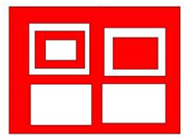
The boundary string can consist of any number of closed segments with a single level of nesting. The direction of these segments (clockwise or anticlockwise) is not important. Imagine that you are viewing a surface along the normal to the plane used during surface creation (that is, looking directly at the plane), the rules for clipping are:
|
| Define output layer | The name for the new layer that the result is output to. This layer is not saved. If you want to keep the data produced, save the layer before you reset graphics or exit Surpac. |
Output
The new layer contains the section strings. You can switch the coordinate data fields in the strings, using STRING MATHS, to change them to plan view. Or, if you used an oblique axis, you can transform the section coordinates to real world coordinates.
When sectioning surfaces created on non-horizontal planes, the process is:
- The axis line is projected onto the plane.
- The surface and axis line are transformed so that the plane and axis line are horizontal.
- The section extraction process proceeds as for a horizontal plane surface.
Note: If the number of string segments produced from the upper and lower DTMs are different for any section, the strings formed will not be closed.
Troubleshooting
| Message | Description |
|---|---|
There are no valid DTMs loaded in Graphics
|
This function cannot be performed as there are no valid DTMs that can be used to take sections. |
The selected were not created on the same plane.
|
The DTMs used must be created on the same plane. Choose different DTMs and recreate the DTMs on the same plane, or transform the data in one of the DTMs to match the plane of the other. |
You can use this function with a clipped DTM, created by GRAPHICALLY CLIP DTM. However, GRAPHICS SECTION DTM might run more slowly if the clipped DTM has a boundary that is concave in nature, for example:
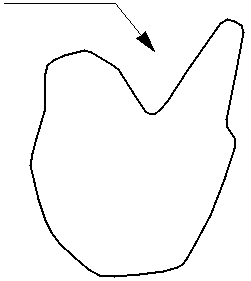
You will get a faster result if you use an unclipped DTM and nominate the boundary string in the GRAPHICS SECTION DTM function.