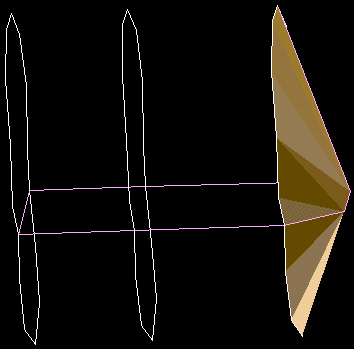
Triangulate End Connected Segments
Choose this function if you a close segment that must have a set of triangles produced that close off one side of the segment entirely. This function has a similar goal to TRIANGULATE INSIDE, but this function should only be used if there are connecting segments that define the shape of the end cap in three dimensions. If there is no extra detail, then TRIANGULATE INSIDE must be used.
To run this function: Choose Solids > Triangulate > Connected segments > End, or...
Several connected segments on one end of a set of data can be triangulated. Triangles will be created from one closed segment to all connected segments on one side of that segment, creating an open trisolation. A point on the side to be triangulated must be selected. After creating the solid, you should validate the solid to check for errors in the triangulation. A valid solid will be formed when all segments cross at coincident points, and sufficient control strings exist. Invalid solids can be created when:
- Lines pass through or very near to points.
- Two or more points are very close to one another, but not coincident.
- Two lines intersect in 3D, but do not contain any points where they intersect.
These problems can be solved by ensuring that wherever two segments cross, they contain exactly coincident points. If all segments cross at coincident points, adding more control strings near the error can also help. Control strings can be open or closed, and be of any string or segment number and direction, but must be snapped to existing points.
One thing to note is that you do not have to choose the segment closest to where the cap is, you can pick any closed segment. When you do the end cap, it will triangulate from that segment onwards.
There are some general guidelines that should be followed to get the most out of this function. For a description of the algorithm used to create the triangulation, go here.
 Note: The algorithm uses a semi-random approach to producing the final
triangulation. This will cause consecutive runs of the functions to potentially
cause different results. If a particular data set is producing good results
sometimes, and bad results other times, it is an indication that more
control is required to consistently produce a good solid.
Note: The algorithm uses a semi-random approach to producing the final
triangulation. This will cause consecutive runs of the functions to potentially
cause different results. If a particular data set is producing good results
sometimes, and bad results other times, it is an indication that more
control is required to consistently produce a good solid.
Form options
Object and Trisolation
The Object and Trisolation fields defined what object will be created.
Selection Method
- Graphical. With this method, you manually select what segment you want to produce an end cap for. After picking what segment we want to cap, you then have to pick a point on the cap detail itself. This is done so the function knows which side it needs to triangulate.
- Segment range. This option allows you specify the String ID, segment number, and the point in 3d space using manual entry instead of graphically. This can be very useful if you are writing a macro to automate a large number of end caps.
Triangulation algorithm
This option is used to control the normal generating aspect of the triangulation procedure (described in detail here). This option is generally only turned off if you are having trouble creating a valid triangulation, and there are some difficult situations that the algorithm has to deal with. Some of these could be:
- The segments that connect the closed cross sections lie on exactly the same plane as that cross section. This makes some of the work incredibly difficult.
- There are more than four line segments coming out of any one point. This is a situation that should be avoided in general, but turning off this option may help.
Examples:
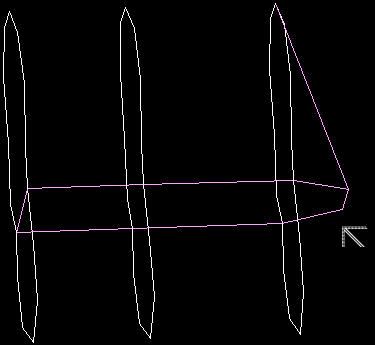
Graphical selection and triangulation of the end of a solid
Select a segment to include in the triangulation
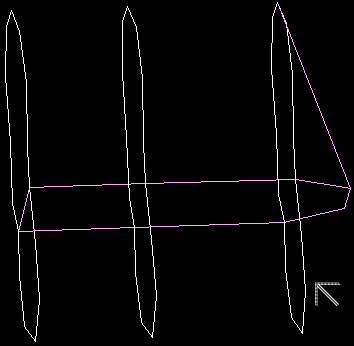
Select a point that is on the same side as the end cap being triangulated