Road design concepts
There are several concepts that you should understand before starting this tutorial.
Inflection point
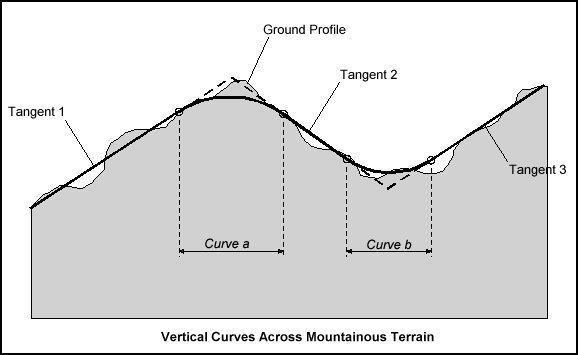
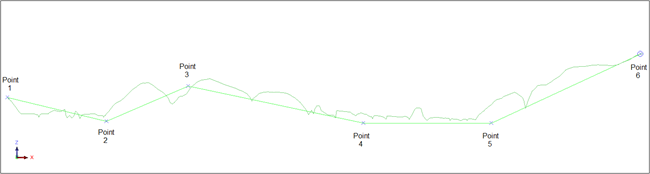
Most roads are designed from inflection points, which define a change, or inflection, in the horizontal or vertical orientation of the road. The lines on either side of an inflection point define tangents to the curve.
Simple curve
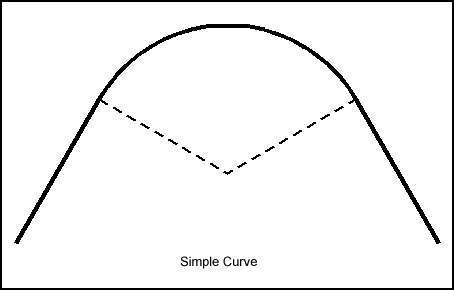
A simple curve is a curve of constant radius from one tangent line to another. This curve type does not allow for transitions from the straight to the maximum curvature, and should only be used in situations where vehicle velocity is at a minimum.
Spiral or transition curve
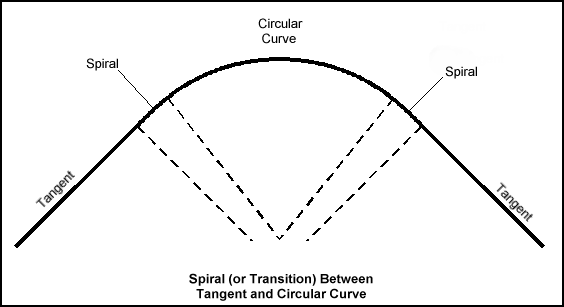
This is the most common form of curve creation in Road Design. A spiral (or transition) exists between the tangent and the circular curve. This allows the vehicle to gradually increase its radius of curvature as it travels around the corner until it reaches maximum curvature.
Superelevation
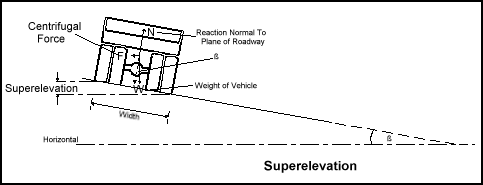
The effect of centrifugal force on a vehicle as it passes through a curve must be countered by raising the outer edge. This process is known as superelevation. The outer edge is raised incrementally through the transition curve until the beginning of the circular curve where it remains constant until the exit transition curve where the outer edge is incrementally lowered.
Vertical curve
A vertical curve exists in a vertical plane. Vertical curves consist of a simple curve with or without spiral (or transition) curves on either side.