Krige Solids
You can estimate a single grade value for one or more solid models
using ordinary kriging with this function. You do not need to create a
block model to run this function.
To run this function: Choose Block model > Geostatistics > Krige solids, or...
- In the Function Chooser, type DIRECT KRIGING, and press ENTER.
You should be thoroughly familiar with geostatistics in order to properly utilise this function.
In particular, you should note the relationship between the dimensions of the solid for which the grade is estimated and the ranges of the variogram model.
If such dimensions are significantly greater than the ranges, then the estimate tends toward a simple arithmetic average of the informing samples (the extension and dispersion variances tending toward the variance of the data set used for the variography).
Procedure
- Choose Geostatistics > Krige solids.
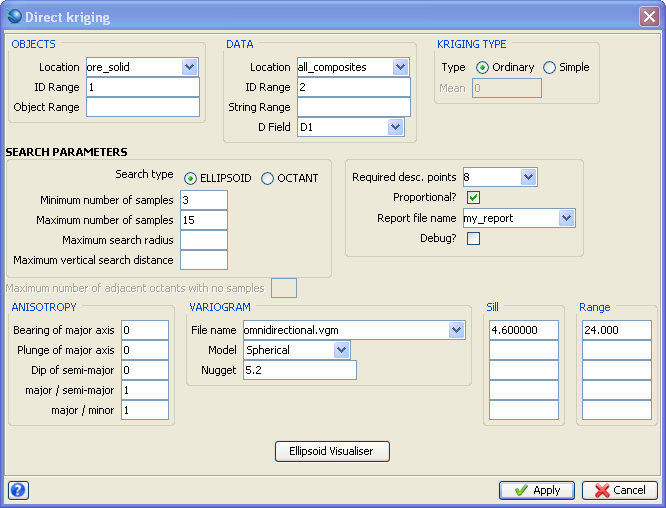
| Form Feature |
Description |
OBJECTS
Location, ID Range, Object Range
|
Specify the DTM files and the objects contained in those files which comprise the solids that are to be kriged.
Each closed trisolation will be processed separately. |
DATA
Location, ID Range, String Range, D Field |
Enter the Location and ID range of the string files containing the candidate informing samples.
Enter the String range and the description field to define the data from the string file or files which are to be used for estimation. |
KRIGING TYPE
Type, Mean |
Select whether you wish to perform Ordinary Kriging or Simple Kriging.
Simple Kriging is similar to Ordinary Kriging except that the weights do not sum to 1.0.
Simple Kriging uses the average of the entire data set while Ordinary Kriging uses a local average (the average of the scatter points in the kriging subset for a particular interpolation point).
Simple Kriging thus requires that you specify the mean (and remove it) prior to modelling the second order effects. |
| SEARCH PARAMETERS |
|
| Search type |
Enter the search type which may be ELLIPSOID or OCTANT.
A 3D ellipsoid search can be used if the data points used are reasonably distributed with no significant clustering.
It simply uses the nearest samples to the block up to the maximum number specified.
An octant search should be used where there is significant clustering of the samples.
It divides the horizontal plane into eight equal areas and takes up to n/8 samples from each octant for use in the estimation where 'n' is the specified maximum number of samples.
If there are too many empty adjacent octants around a block then that block will not be estimated. |
| Minimum number of samples |
This sets a lower limit on the number of samples to use for a valid estimation. An example value is 3. |
| Maximum number of samples |
This sets an upper limit on the number of samples to use to minimise processing time. An example value is 15. |
| Maximum search radius |
The maximum search radius is used in conjunction with the maximum number of samples to select samples to be used in the kriging calculations.
It should generally (although not necessarily) be set to a value slightly greater than the range of the variogram of the major axis.
The exception to this would be where it has been established that the Kriging Weights based on a typical block / sample configuration tend to zero at a distance shorter than this range.
While the range of the variogram gives the maximum distance at which there is some correlation between data points, it is the magnitude of the kriging weights that ultimately determine the distance to which significant samples will be found.
The maximum search radius is measured in the direction of the major axis.
The search distances for the semi-major and minor axes are influenced by the anisotropy ratios which are used to define the shape of the ellipsoid.
Only if these ratios are both equal to 1.0 will the maximum search radius be equal in all directions. |
| Maximum vertical search distance |
This distance is used to exclude samples that are greater than the maximum vertical search distance from the kriging calculations.
If 2-dimensional kriging is required, then this distance should be set to a value less than the vertical length of the samples used.
If 3-dimensional kriging is required, then the vertical distance can be set to quite a large value.
In orebodies that show definite layers, such as coal deposits or lateritic deposits, the vertical search would normally be set to the thickness of the deposit.
Note that this is a VERTICAL search distance and is not influenced by the orientation of the search ellipsoid.
To be used in estimating a value for a block, a point must first fall within the search ellipsoid and it must also be within the maximum vertical search distance. |
| Maximum number of adjacent octants with no samples |
This defines the maximum number of adjacent octants which may have no samples and yet calculations will still be performed (octant search only). |
| Required desc. points |
Enter the minimum number of descretisation points to be generated for each trisolation. An example value is 8. |
| Proportional? |
The descretisation points generated will be evenly distributed through the solid.
If the Proportional check box is selected , the spacing between the descretisation points will be proportional to the XYZ dimensions of the solid.
If the check box is cleared, it will result in a set of descretisation points with a constant XYZ spacing. |
| Report file name |
Specify a name for the file to which output will be written.
The kriged estimate and kriging variance along with the estimation parameters will be written to <location>.not and the descretisation points to <location>9999.str. |
| Debug? |
Select the check box if you want an extended report (including information regarding the informing samples).
Additional information includes:
Estimated Grade
Kriging variance
Standard deviation * 2
Kriging efficiency = (block variance - kriging variance) / block variance
Slope of regression = standard deviation / Estimated grade
Conditional bias slope = (block variance - kriging variance + | LaGrange |) / (block variance - kriging variance + |2 * LaGrange |)
|
ANISOTROPY
Bearing of major axis |
This is the bearing of the major (long) axis of the anisotropy ellipsoid. An example value is 0. |
| Plunge of major axis |
This is the angular displacement of the major axis from the horizontal in a vertical plane through the major axis.
The displacement is negative if the major axis plunges downwards. An example value is 0. |
| Dip of semi-major |
This is the angular displacement of the semi-major axis from the horizontal in a vertical plane normal to the major axis.
The displacement is positive if the dip is to the left . looking down the plunge of the major axis. An example value is 0. The following image shows tilt about major axis.
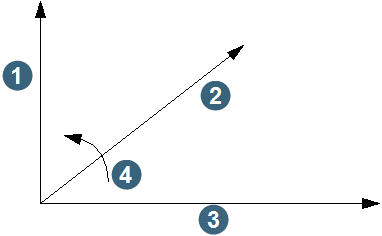
1. minor axis
2. major axis
3. semi-major axis
4. positive tilt direction
|
| major/semi-major |
This is the ratio of the length of the major axis to the length of the semi-major axis. An example value is 1. |
| major/minor |
This is the ratio of the length of the major axis to the length of the minor axis. An example value is 1. |
| VARIOGRAM File name |
Enter the file name containing the variogram model parameters to use.
After a value is selected and focus is moved to another field on this form, the file will be read and the variogram model parameters will be populated into the variogram parameter fields.
These fields can be modified if necessary before applying the form. Leave this field blank if the variogram model parameters to use have not been saved to a file. |
| Model |
Select the model type (Spherical, Exponential,
Gaussian, or Hole Effect) to be used for the kriging. |
| Nugget |
This is the nugget (Co) value for the model. An example value is 5.2. |
| Sill, Range |
Enter the sills (Cn) and ranges (a) for each structure in the variogram model.An example value for Sill is 4.6. An example value for Range is 24. |
- Fill in the fields on the Direct kriging form.
- Click Apply.
Messages
Insufficient number of samples found for processing
No samples could be extracted from the specified strings using the specified description field.
Could not prepare indexed points
The samples extracted as candidate informing samples could not be indexed.
No objects found
No trisolations could be extracted from the specified objects.
Results written to ???
Results and parameters have been written to the given file
Error saving strings to file ???
The descretisation points could not be written to the given string file.
Object ??? Trisolation ??? not closed
The given trisolation is not closed and so can not be processed.
Object ???, Trisolation ??? - only ??? informing samples could be found (??? required)
Not enough informing samples could be found for the estimation.
Decrease the minimum number necessary or relax the search radius.
Object ???, Trisolation ??? - only ??? descretisation points could be extracted (??? required)
The required minimum number of descretisation points could not be generated for the given trisolation.
Decrease the required number of descretisation points.
Object ???. Trisolation ??? - Error solving kriging system
An error occurred trying to solve the kriging system - this may be caused by duplicate samples.



 Direct kriging form.