


Simple Kriging
Simple Kriging is similar to Ordinary Kriging except that the weights of all samples used in an estimation are not required to sum to 1.0. Simple Kriging uses the average of the entire data set while Ordinary Kriging uses a local average (the average of the scatter points in the kriging subset for a particular interpolation point). Simple Kriging thus requires that the mean be specified (and removed) prior to modeling the second order effects.
To run this function: Choose Block model > Estimation > Simple kriging, or...
Before using this function you must have variogram model parameters, anisotropy ratios, and other geostatistical parameters.
Attribute Name
Enter the name of the attribute to be modelled.
Choose Apply to display the ESTIMATION ATTRIBUTES form or Cancel to exit the function.
A number of parameters relating to the informing samples may be extracted and stored. Enter the name of the attribute for each of the available parameters.
Anisotropic distance to nearest sample
The anisotropic distance to the nearest informing sample. This must be A real or float attribute.
Average anisotropic distance to samples
The average anisotropic distance to all informing samples. This must be A real or float attribute.
Number of samples
Number of informing samples. This must be an integer attribute.
Kriging variance
Kriging variance is the error incurred in estimating the block from the point samples less the inherent variance of points within the block. Kriging variance can be used for ore classification (measured, indicated, inferred, or proven, probable and possible).
Choose Apply to display the DATA SOURCE SPECIFICATIONS form, or Cancel to return to the SELECT ATTRIBUTE TO MODEL form.
Data source type
The data may come from either a STRING FILE or a BLOCK MODEL.
Location, ID range, String range, D field
If the data source is a string file you must complete each of these inputs to describe the string file or files from which the sample data is to be obtained.
Enter the Location and Id range of the required string files. Enter the String range and the description field to define the data from the string file or files which are to be used for estimation.
Model name and Attribute
If the data source is Block Model then you must enter the name of the block model and the attribute field within that model which is to be used as the data source for estimation.
Constrain data
Select this checkbox if you wish to restrict data selection or leave it unchecked for unconstrained selection. See Make Constraint.
Constraining the data effectively removes all sample points which are not required from the estimation process completely.
Special note:
Constraining the data source uses a block model constraint to determine which sample points to select. Consequently, if using a geometric constraint like inside a 3DM, above a DTM, etc., the sample points selected will not comply exactly with the geometric boundary. Rather they will be consistent with the block model constraint of the geometric boundary. This is an approximation which is dependent on the block model resolution.
If you checked the Constrain data field the following field will appear:
Save constrained sample points?
Saving the constrained sample points to a string file can be used to confirm the correct constraint has been applied.
If you checked the Save constrained sample points? field the following two fields will appear:
Output location
Enter the location for the string file for saving the constrained points.
Output id number
Enter the ID for the string file for saving the constrained points.
Choose Apply to display the SEARCH PARAMETERS form or Cancel to return to the ESTIMATION ATTRIBUTES form.
Search type
Enter the search type which may be ELLIPSOID or OCTANT.
A 3D ellipsoid search can be used if the data points used are reasonably distributed and do not show any significant clustering. It simply uses the nearest samples to the block being estimated up to the maximum number of samples specified.
An octant search should be used where there is significant clustering of data points. It divides the horizontal plane into eight equal areas and takes up to n/8 samples from each octant for use in the estimation where 'n' is the specified maximum number of samples. If there are too many empty octants around a block then that block will not be estimated.
Use the Ellipsoid Visualiser to assist in defining your search ellipsoid.
Minimum number of samples to select
This sets a lower limit on the number of samples to use for the estimation so as to ensure a valid estimation.
Maximum number of samples to select
This sets an upper limit on the number of samples to use for the estimation to minimise processing time.
Maximum search radius
The maximum search distance is used in conjunction with the maximum number of samples to select samples to be used in the kriging calculations. It should generally (although not necessarily) be set to a value slightly greater than the range of the variogram of the major axis. The exception to this is where it has been established that the kriging weights based on a typical block / sample configuration tend to zero at a distance shorter than this range. While the range of the variogram gives the maximum distance at which there is some correlation between data points, it is the magnitude of the kriging weights that ultimately determine the distance to which significant samples will be found.
The maximum search radius is measured in the direction of the major axis.
The search distances for the semi-major and minor axes are influenced by the anisotropy ratios which are used to define the shape of the ellipsoid. Only if these ratios are both equal to 1.0 will the maximum search distance be equal in all directions.
Maximum vertical search distance
This allows rejection of a data point if it is too far away vertically from the block to provide a meaningful estimation. Note that this is a VERTICAL search distance and is not influenced by the orientation of the search ellipsoid. To be used in estimating a value for a block, a point must first fall within the search ellipsoid and it must also be within the maximum vertical search distance.
Constrain by drill hole?
This option allows you to constrain sample points by selecting a limited number from each drill hole. This option will only appear if you defined your data to be from a string file (ie it won't appear if you have defined block model data).
If you checked the Constrain by drill hole? field the following two fields will appear:
Desc field
Enter the description field that contains the drill hole id. Hint: String file data is often produced from Surpac compositing functions. Each compositing function describes which description field the hole id is saved to, so the online documentation for the compositing function of interest should be reviewed for further details on where the hole id is stored.
Maximum number of samples per drill hole
Enter the maximum number of samples per hole that can be used in the estimation.
Maximum number of adjacent octants with no samples
This defines the maximum number of adjacent octants which may have no samples and yet calculations will still be performed (octant search only).
Bearing of major axis
This is the bearing of the long axis of the search ellipsoid. The anisotropy defined by this ellipsoid is used to determine the distances of samples from the block centroid in order to select those that will inform the estimate.
Plunge or pitch of major axis
This is the angular displacement of the major axis from the horizontal in a vertical plane through the major axis. The displacement is negative if the major axis plunges downwards.
Plunge is measured from a horizontal plane (measured from X or Y when rotation convention is ZXY or ZYX) and pitch is a measurement form an inclined plane (measured from Z axis if the rotation convention is ZXZ or ZYZ).
Dip of semi-major axis
This is the angular displacement of the semi-major axis from the horizontal in a vertical plane normal to the major axis. The displacement is positive if the dip is to the left looking down the plunge of the major axis .
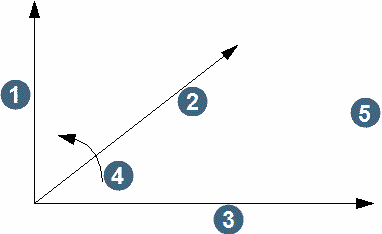
1. minor axis
2. major axis
3. semi-major axis
4. positive tilt direction
5. tilt about major axis
ANISOTROPY RATIOS
major / semi-major
This is the ratio of the length of the major axis to the length of the semi-major axis.
major / minor
This is the ratio of the length of the major axis to the length of the minor axis.
Choose Apply to display the KRIGING PARAMETERS form or Cancel to return to the DATA SOURCE SPECIFICATIONS form.
Variogram file name
Enter the file name containing the variogram model parameters to use. After a value is selected and focus is moved to another field on this form, the file will be read and the variogram model parameters will be populated into the variogram parameter fields. These fields can be modified if necessary before applying the form. Leave this field blank if the variogram model parameters to use have not been saved to a file.
Variogram model
Enter the model type which is to be used for kriging. This may be one of Spherical, Nested Spherical, Exponential, Gaussian, or Hole Effect.
Number of structures
If a Nested Spherical model is selected, specify the number of structures (1 to 5). For all other model types, this will be ignored.
Nugget(Co)
This is the nugget value for the model.
Sill(C(#))
This is the difference between the total sill and the nugget. A value for each structure is required.
Range (A(#))
This is the range of the model. A value for each structure is required.
ANISOTROPY PARAMETERS (one per structure)
Bearing
This is the bearing of the long axis of the anisotropy ellipsoid for this structure. The anisotropy defined by this ellipsoid is used to determine the distances of informing samples from the block centroid. The defaults provided are those of the search ellipsoid.
Plunge
This is the angular displacement of the major axis from the horizontal in a vertical plane through the major axis. The displacement is negative if the major axis plunges downwards.
Dip
This is the angular displacement of the semi-major axis from the horizontal in a vertical plane normal to the major axis. The displacement is positive if the dip is to the left looking down the plunge of the major axis.
Major/Semi
This is the ratio of the length of the major axis to the length of the semi-major axis.
Major/Minor
This is the ratio of the length of the major axis to the length of the minor axis.
Number of descretisation points
These points will be distributed evenly through the block to provide targets for estimation and will then be averaged to provide an estimate for the entire block.
Include debug output
Check this box if you want an extended report or leave it unchecked if you want only a summary of the estimation parameters.
Additional information include:
- Estimated Grade
- Kriging variance
- Standard deviation * 2
- Block variance
- Kriging efficiency = (block variance - kriging variance) / block variance
- Slope of regression = standard deviation / Estimated grade
- Conditional bias slope = (block variance - kriging variance + | LaGrange |) /
(block variance - kriging variance + |2 * LaGrange |)
Constrain interpolation
Check this box if you wish to restrict the blocks to be estimated inside a constraint. Leave the box unchecked for unconstrained interpolation. See Make Constraint.
Choose Apply to perform kriging estimation or Cancel to return to the SEARCH PARAMETERS form.
Report file name
You must enter a name for the report file which will contain estimation parameters.
Format
The output report can be created as
- .NOT - Surpac text file
- .CSV - Comma Separated Variable (spreadsheet)
- .HTM - Hypertext Markup Language (web)
- .HTML - Hypertext Markup Language (web)
- .RTF - Rich Text Format (Microsoft Word)
- PDF - Adobe Acrobat
- .PS - Postscript
- .LOG - Surpac log file
Result
A value will be estimated for the nominated attribute within the blocks selected by the search ellipsoid and constraints.
Messages
WARNING - Negative kriging variance - check block size and/or number of descretisation points
A negative kriging variance will occur if the dispersion variance of a block is greater than the weighted average extension variance of the samples informing the block. This may be due to overly large blocks relative to the spacing between samples, an insufficient number of descretisation points used to characterise the block, or an unfortunate coincidence of sample and descretisation points. No block will be written where a negative kriging variance occurs. If it becomes obvious that negative kriging variances are being calculated for each block, the function may be halted using the ABORT key.