


GSLIB indicator kriging
To run this function: Choose Block model > Estimation > GSLIB > Indicator kriging, or...
Files Tab
Input
Location, ID number, String range, D-field
You must complete each of these inputs to describe the string file or files from which the sample data is to be obtained. Enter the Location and Id range of the required string file. Enter the String range and the description field to define the data from the string file which are to be used for estimation. The specified data will be converted from a string file to the geoEAS format input file that GSLIB requires.
Variable type
Select whether the data is categorical (eg. representing rock types) or continuous (eg. representing gold grades).
Minimum
All samples strictly less than this value are ignored. The default value is -1E+21.
Maximum
All samples strictly greater than this value are ignored. The default value is 1E+21.
Output
Constrain interpolation
If you want to estimate a subset of the block model blocks by use of a block model constraint, select this box.
Debug file
The name of the GSLIB debug file to create.
Debug level
The higher the debugging level, the more output. The normal levels (none, low) summarize the results. Medium and high provide all the kriging matrices and data used for the estimation of every point/block. It is recommended that you do not use a high debugging level with a large block model.
Clean up
When the form is applied, several (temporary) files are created, either for input to GSLIB or as output from GSLIB. If you check this box, the temporary files are deleted.
Cutoffs Tab
Soft data
If you wish to use already transformed indicator values in addition to the sample data, check this box.
Location, ID Number, String range
If you selected Soft data, you must complete each of these inputs to describe the string file or files from which the sample data is to be obtained. Enter the Location and Id range of the required string file. Enter the String range to define the data from the string file which are to be used for estimation. The specified data will be converted from a string file to the geoEAS format input file that GSLIB requires. A D-field containing soft data for each Threshold / Category must be specified in the table below.
Threshold / Category
The cutoff (for continuous data) or category (for categorical data).
cdf / pdf
The global cdf value (for continuous data) or global pdf value (for categorical data). This is only used in Simple kriging - see the Kriging Options tab, or if there is no sample data for this cutoff).
Attribute
Specify the block model attribute that will store the conditional probability or conditional cdf value for this cutoff. Unestimated nodes are identified by all conditional cdf values equal to -9.9999.
D-field
If you are using already transformed indicator values (soft data) in addition to the sample data, specify which D-field of the soft data string file contains data for this Threshold / Category.
Kriging Options Tab
Full IK
If Full IK is selected, then a Full IK is performed. If Median IK is selected, then a Median IK approximation is performed where the kriging weights from the category or cutoff closest to the specified IK cutoff are used for all cutoffs.
IK cutoff
The kriging weights from the category or cutoff closest to this value will be used for kriging. The default value is 2.5.
Kriging Type
Specify which type of kriging to use.
- Simple kriging
- Ordinary kriging
Maximum samples per octant
The maximum number of samples per octant (octant search is not used if this value is left at 0). The octant search ensures that data are taken on all sides of the point being estimated. This is particularly important with drillhole data. An octant search ensures that data is sourced from more than one drillhole.
Minimum samples to krige a block
The minimum number of data points to use for kriging a block. If fewer than this number of samples are found, the block will be left unestimated. The default value is 4.
Maximum samples to krige a block
The maximum number of data points to use for kriging a block. For example, specifying 8 uses the closest eight sample points to the centroid of the block being sampled.
Search radius
The search radius in the maximum horizontal direction (hMax), the minimum horizontal direction (hMin) and the vertical direction (Vert). See Ellipsoid Definition for more detail on specifying these radii.
Search angles
The angle parameters that describe the orientation of the search ellipsoid. See Ellipsoid Definition for more detail on specifying these angles.
Variograms Tab
You must specify a variogram for each Threshold / Category.
An acceptable variogram model for indicator kriging in GSLIB consists of a nugget effect and any positive linear combination of standard variogram models: spherical, exponential, power or hole effect.
Nugget
Specify the nugget constant for the variogram.
Type
Select the type of structure represented by this line of the table. The structure types supported by GSLIB for Indicator Kriging are:
- Spherical
- Exponential
- Power
- Hole effect
Cc
Specify the c parameter for this structure. Using a spherical example, a typical value is 0.97.
hMax
Using a spherical example, a typical value is 42.3.
hMin
Using a spherical example, a typical value is 42.3.
Vert
The maximum horizontal range, minimum horizontal range and vertical range. See Ellipsoid Definition for more detail on specifying these values. Using a spherical example, a typical value is 42.3.
Angle1
Using a spherical example, a typical value is 0.
Angle2
Using a spherical example, a typical value is 0.
Angle3
Specify the angles defining the geometric anisotropy. See Ellipsoid Definition for more detail on specifying these angles. Using a spherical example, a typical value is 0.
Post Processing Tab
Post processing is possible for kriged results of indicators of continuous variables.
Output type
Select whether to compute:
E-type estimate, i.e., the mean value of the conditional distribution,
Estimate
Specify a block model attribute to store the estimate.
Probability and means above and below ... a fixed threshold,
Threshold
The Threshold of interest
probability > Threshold
Specify a block model attribute to store the probability of exceeding the threshold
mean > Threshold
Specify a block model attribute to store the mean value above the threshold
mean < Threshold
Specify a block model attribute to store the mean value below the threshold
Z percentile corresponding to ... a fixed conditional cumulative distribution function (cdf) value,
cdf
The cdf value of interest
z value
Specify a block model attribute to store the z value
Conditional variance of the conditional distribution,
Conditional variance
Specify a block model attribute to store the variance
Volume support correction
Volume correction
Check this box to perform volume support correction.
Type
Select whether to perform Affine correction or Indirect correction.
Variance reduction factor
Specify the variance reduction factor, for example 0.75.
Indicator extrapolation
Number of descretization points
The number of regularly spaced conditional cdf values to calculate when performing volume support correction and computing results. The default value of 50 is generally fine.
Min data value
The minimum data value allowed, for example 0.
Lower tail
Select the method of extrapolation to the lower limit.
w
Specify the power model parameter.
Middle
Select the method of interpolation within the distribution.
w
Specify the power model parameter.
Max data value
The maximum data value allowed, for example 0.
Upper tail
Select the method of extrapolation to the upper limit.
w
Specify the power model parameter.
Tabulated values
If table lookup values are required by one of the interpolation / extrapolation options, a file of the tabulated values is required.
File
The name of the geoEAS formatted file of z data providing details between the IK thresholds.
Variable
The column for the values that will be used for the global distribution.
Weight
The column for the (declustering) weights that will be used for the global distribution.
Results
Press Cancel to cancel the function or Apply to invoke GSLIB.
The flow of data is:
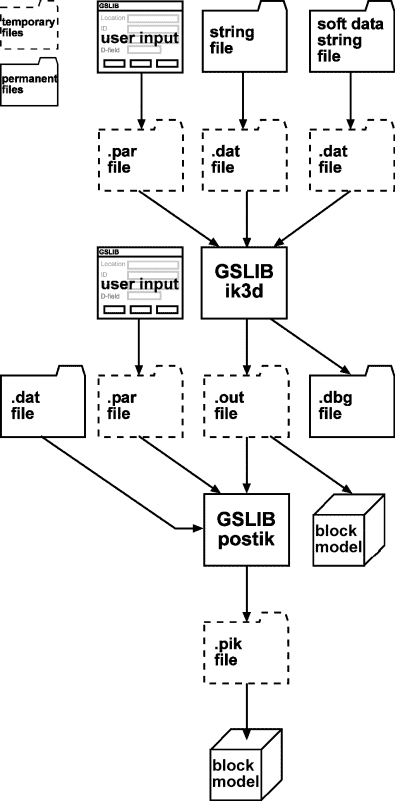
Indicator kriging with GSLIB is a two step process:
- GSLIB (ik3d) requires a sample (.dat) file, a parameter (.par) file and (optionally) a (.dat) file of "soft" sample data.
The sample and soft (.dat) file(s) are created from the specified string file(s) and the form input is used to create the parameter (.par) file.
The file names are created from the location of the sample file and the relevant file name extension.
GSLIB (ik3d) creates two files, a (.out) file of kriged results and a (.dbg) file with information about the kriging results. The kriged results are automatically loaded into the specified block model attributes. The GSLIB screen output is written to the message window prefixed with:
GSLIB>
After GSLIB (ik3d) has finished kriging, further post processing can be performed by GSLIB (postik).
- GSLIB (postik) requires a GSLIB (ik3d) output (.out) file, a parameter (.par) file and (optionally) a (.dat) file of tabulated data for indicator extrapolation / interpolation.
The GSLIB (ik3d) output (.out) file is created by GSLIB (ik3d), the form input is used to create the parameter (.par) file and the (.dat) file of tabulated data must be created by you.
GSLIB (postik) creates one file, a (.pik) file of results. The results are automatically loaded into the specified block model attribute(s). The GSLIB screen output is written to the message window prefixed with:
GSLIB>
If you selected Clean up on the Files tab, the temporary files will be deleted after the results have been loaded into the block model.
Messages
Removing GSLIB intermediate files.
You selected Clean up on the Files tab, so the temporary files created for or by GSLIB are being removed.
Error loading file filename0.str
There was an error loading the specified string file.
You must select a model first.
You must open a block model before you can use this function.
File c:\Program Files\Gslib90\ik3d.exe not found
File c:\Program Files\Gslib90\postik.exe not found
ik3d.exe or postik.exe could not be found in the specified directory. Make sure the gslib90 user option is pointing to the directory containing ik3d.exe.
Invoking "c:\Program Files\Gslib90\ik3d.exe" sample.par ...
Invoking "c:\Program Files\Gslib90\postik.exe" sample2.par ...
ik3d.exe or postik.exe is being invoked with the specified parameter file.
You have terminated "c:\Program Files\Gslib90\ik3d.exe" sample.par. Results were not loaded.
You have terminated "c:\Program Files\Gslib90\postik.exe" sample2.par. Results were not loaded.
You chose to abort the kriging process. This terminated the executable using the progress feedback cancel button before the results were loaded.
"c:\Program Files\Gslib90\ik3d.exe" sample.par terminated prematurely. Results were not loaded.
"c:\Program Files\Gslib90\postik.exe" sample2.par terminated prematurely. Results were not loaded.
ik3d or postik crashed or otherwise ended prematurely (for example, it was terminated outside of Surpac by using Task Manager) before the results were loaded.
Error writing file "sample.dat".
Error writing file "sample.par".
Error writing file "sample2.par".
An error occurred while writing the specified file. Check that there is enough room to write the file.
Error opening file sample.dat
Error opening file sample.par
Error opening file sample2.par
An error occurred while trying to open the specified file for writing. Check that the file is not read-only or in use by another process.
Error opening file sample.out
Error opening file sample.pik
An error occurred while trying to open the specified file for reading. Check that ik3d.exe did not end prematurely and that the file is not in use by another process.
Created sample.dat.
Created sample.par.
Created sample2.par.
The specified file was successfully created.
You have terminated the loading of results. Results were only partially loaded.
You chose to abort the block model loading process.
Number of blocks estimated 4096
The number of blocks actually informed is reported.
Attribute mean does not exist
The specified block model attribute does not exist. Select a different Mean or Drift Attribute.