



About reblocking and attributes of multiple percentile block models
When a block model is reblocked, properties for the attributes in the target reblocked model are copied from the attributes of the source block model. They include:
- the number of decimals places for formatted output
- a description
- the default or background value
The percentage and fraction attributes use these properties:
- There are six decimal places.
- The default or background value is zero.
- The description is "block fraction/percentage".
Calculations of attributes
There are a few types of attribute calculations.
Average attributes
The most common attributes found in a block model represent grade which are expressed as values per unit of volume or mass. Attributes that must be weighted by mass require a density (specific gravity) attribute to be present in the model.
The calculations used to determine the average grade and fractional volume for a new block being created for a specific group and category are shown below.
 Note: If the attribute is not weighted by density, the D component is removed from the calculations.
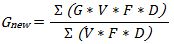
Where:
- Gnew is the grade for the new block.
- Fnew is the fraction of the new block represented by the group and category being processed.
- Σ is the summation of all blocks that are wholly or partially in the volume encompassed by the new block being created that have the group category of interest. For example, waste is represented where material = 0.
- G is the grade from the original block.
- V is the volume of the original block.
- F is the fraction of the original block that is inside the new block being created.
- D is the density (specific gravity) of the original block.
Aggregate attributes
Attributes which represent the contained metal in a block, such as grams of gold, are often found in models. These types of attributes are aggregate attributes.
The calculations to determine the contained metal and fractional volume for the new block being created for a specific group and category are shown below.



Where:
- Mnew is the contained metal for the new block.
- Fnew is the fraction of the new block that is represented by the group and category being processed.
- Funclass is the unclassified material. Unless a block model has voids, when doing simple numeric calculations, this value should always be zero. When doing multiple percentage calculations using groups and categories, this value may be non-zero if some blocks in the source model have no category assigned.
- Σ is the summation of all blocks that are wholly or partially are in the volume encompassed by the new block being created that have the group category of interest. For example, waste is represented where material = 0.
- M is the contained metal from the original block.
- F is the fraction of the original block that is inside the new block being created.
Unclassified volumes
The unclassified category is special in that the percentage (or fraction) of the volume is determined by the difference between 100% (or 1.0 if using fractions) and the sum of the percentage values of the other categories for the group being processed.
There are two common reasons for a grouping category to have unclassified volumes:
- A block may have not explicitly been assigned a value. While scanning the blocks, or during processing, some will be found to have no value or background value.
- There are voids because there are regions in the block model that are not represented by blocks.
Attributes that represent average grade or metal content for the unclassified category will typically be the same as the ones used for other categories of the same group.