


Block model inverse distance estimation
You use this function to estimate values based on the weighted values of data points closest to the block centroid. The weighting is the inverse of the distance of the data point from the centroid raised to a specified power.
To run this function: Choose Block model > Estimation > Inverse distance, or...
You can use a 3D ellipsoid in the estimation process.
The source of sample data can be either a string file or another block model.
You can fill in several attributes at the same time, either from different description fields in the same string file, or from different attributes in the filling block model.
To run this function: Choose Block model > Estimation > Inverse distance.
Fields on the Data source specifications form
| Field | Description |
|---|---|
| Data source type |
|
| Location | The name of the string files that contain the data you want to use for estimation. |
| Id range | The Id range of string files you want to use for estimation. |
| String range | The range of string files that contain the data you want to use for estimation. |
| Constrain data |
|
| Save constrained sample points |
|
| Output location | The name and directory location where you would like to save the constrained sample points. |
| Output id number | The id number for the string file that contains the constrained sample points. |
| Attribute to fill | The names of the attributes you are modelling. These attributes can be modelled from the same, or different, description fields in the string file, or from different attributes in the block model. |
| Description Field | The description field for the attribute. If you are estimating from a string file, you must complete this field. |
| Attribute Name | The name of the attribute. If you are estimating from a block model, you must complete this field. |
| Anisotropic dist to nearest sample | The attribute to store the anisptropic distance to the nearest informing sample. This must be a real attribute. If the attribute does not already exist then it is created with a background value of -99. If you leave this field blank then the estimation attribute is not stored. |
| Average anisotropic dis to sample |
The average anisotropic distance to all informing samples. This must be a real attribute. If the attribute does not already exist then it is created with a background value of -99. If you leave this field blank then the estimation attribute is not stored. |
| Number of samples | The number of informing samples. This must be an integer attribute. If the attribute does not already exist then it is created with a background value of -99. If you leave this field blank then the estimation attribute is not stored. |
 Note: When you constrain the data source, a block model constraint is used to determine which sample points to select. If you use a geometric constraint that involves a solid or surface, such as inside a 3DM or above a DTM, the sample points selected will not comply exactly with the geometric boundary. Instead they will be consistent with the block model constraint of the geometric boundary. This approximation is dependent on the block model resolution.
Fields on the Search parameters form
| Field | Description |
|---|---|
| Search type |
|
| Minimum number of samples to select | The lower limit on the number of samples to use for the estimation to ensure a valid estimation. |
| Maximum number of samples to select | The upper limit on the number of samples to use for the estimation to minimise processing time. |
| Maximum search radius | The maximum search distance to locate samples for estimation, measured in the direction of the major axis. The search distances for the semi-major and minor axes are influenced by the anisotropy ratios which are used to define the shape of the ellipsoid. Only if these ratios are both equal to 1.0 will the maximum search distance be equal in all directions. |
| Maximum vertical search distance |
The maximum vertical distance to a sample for use in estimation.
|
| Constrain by drillhole? |
|
| Desc field |
The description field that contains the drillhole id. |
| Maximum number of samples per drillhole | The maximum number of samples for each hole, that can be used in the estimation. |
| Maximum number of adjacent octants with no samples | The maximum number of octants, adjacent to a block centroid, that can have no samples. If a block centroid has a greater number of empty octants than this maximum number, the block is not estimated. You can only select this option if you set the Search type to OCTANT. |
| Search Ellipsoid Specifications | |
| Ellipsoid orientation | |
| Bearing | The bearing of the long axis of the search ellipsoid. |
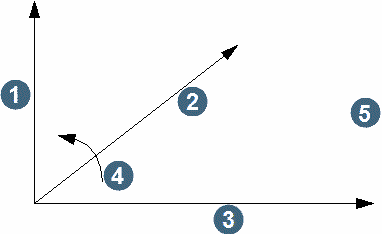
| Plunge | The angular displacement of the major axis from the horizontal in a vertical plane through the major axis. The displacement is negative if the major axis plunges downwards. Plunge is measured from a horizontal plane (measured from X or Y when rotation convention is ZXY or ZYX). |
| Dip |
The angular displacement of the semi-major axis from the horizontal in a vertical plane normal to the major axis. The displacement is positive if the dip is to the left looking down the plunge of the major axis.
1. minor axis |
| Anisotropy ratios | |
| major/semi-major | The ratio of the length of the major axis to the length of the semi-major axis. |
| major/minor | The ratio of the length of the major axis to the length of the minor axis. |
| Rotation Convention | The order of the axis and rotation direction for each axis. The drop down lists commonly used rotations. To define an alternative that is not listed, choose 'Other' and use the option buttons to select the rotation you require. |
Fields on the Inverse distance parameters form
| Field | Description |
|---|---|
| Inverse distance power | The power to which the distances between the data points and the block centroid are raised to provide a weighting for the data. |
| Number of descretisation points |
The number of points that are distributed evenly through the block to provide targets for estimation. The points are averaged to provide an estimate for the entire block. The samples used for calculation at each descretisation point are selected from the block centroid location using either the ellipsoid or octant method.
|
| Include debug output |
|
| Constrain interpolation? |
|
| Report file name | The name of the file to contain the estimation parameters. |
| Format | The file format for the file to contain the estimation parameters. |
Output
The value of the modelled attribute is estimated, and stored in Attribute to fill, for all the blocks that pass any constraint you specified.